

 English



Wimbledon Order Of Play Explained: How The Daily Schedule Works For Ticket Holders
Written by Aviran Zazon | Last updated on March 12, 2026
If you are trying to work out what a Wimbledon ticket might actually get you on the day, the order of play is the most useful document you can check.
It is Wimbledon’s official daily running order by court, and for many fans it is the point where a ticket stops being an abstract booking and starts to look like a real day out.
It still needs reading with a bit of caution. Wimbledon publishes the full order of play late, usually the night before and, on the Queue page, says the next day’s version is available each evening after 8pm.
It tells you which matches are listed on each court and who is on first, but it does not guarantee exact later start times, uninterrupted play, or that a particular player will stay on that court if the schedule changes.
This is vital, whether you are joining the Queue, holding ballot tickets, or paying for a debenture seat on Centre Court or No.1 Court. The practical question is not only what the order of play says, but how much confidence you should place in it.
Centre Court and No. 1 Court
Wimbledon Order Of Play: Fast Answer
The Wimbledon order of play is the official daily schedule listing which matches are due on each court and in what sequence. The full version is released late, usually the night before, with Wimbledon’s Queue guidance pointing fans to the following day’s order of play after 8pm each evening.
For ticket holders, it helps answer four immediate questions:
- Which court has the strongest-looking programme
- Who is first on your ticketed court
- Whether an outside-court day still looks strong
- Whether a late ticket decision now makes more sense than it did the day before
What it does not do is promise exact timings for everything after the first scheduled match, or guarantee that your ticket will include a specific player. Wimbledon’s own terms say tickets do not entitle you to any particular match, number of matches or player.
That is why the order of play matters so much for Centre Court, No.1 Court, ballot holders, Queue joiners and debenture buyers alike. It is a very good guide to the shape of the day, but not a cast-iron script.
And once it appears, some readers decide they want a different court or a stronger-looking day at short notice, which is one reason the resale market becomes more active at that moment.
What ticket holders should take from it quickly
If you only want the practical takeaway, it is this:
- The order of play is essential for understanding the likely shape of your day
- It is especially useful for judging court strength and first-match priority
- It is much less reliable as a precise timetable for later matches
- It has a different impact, depending on whether you are queueing, holding ballot tickets, or buying transferable debenture seats
- It often becomes the trigger for last-minute ticket decisions
What The Wimbledon Order Of Play Actually Is
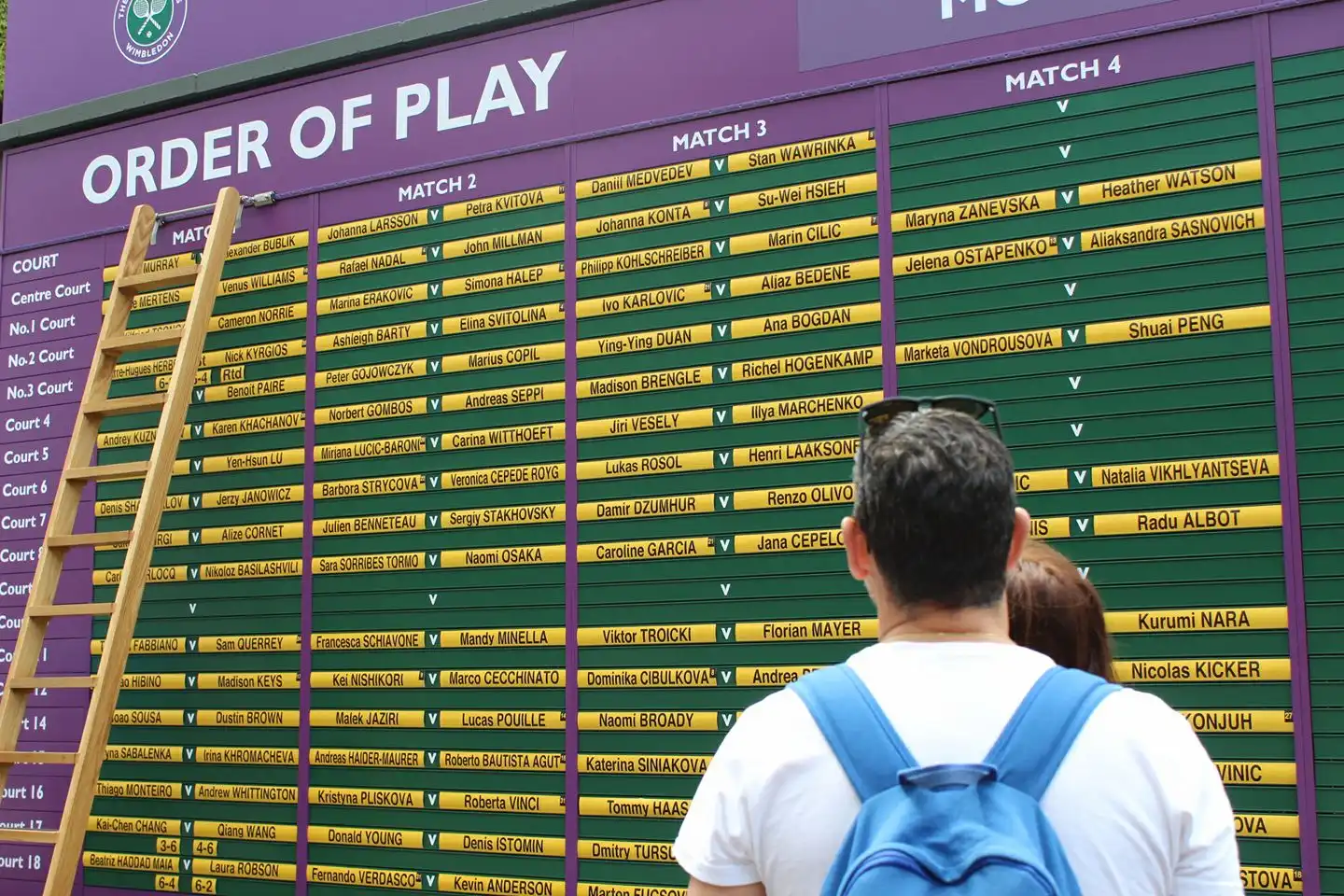
In plain English, the order of play is Wimbledon’s official court-by-court schedule for the next day. It shows which matches are due on Centre Court, No.1 Court and the outside courts, along with the order in which they are planned to be played.
That makes it useful to spectators, not just broadcasters or media. Wimbledon tickets are sold by court access and seat location, not by guaranteed player.
So the difference between a strong Centre Court line-up, a particularly deep No.1 Court programme, or a week-one outside-court card can be huge in practical value even when two fans paid through equally official routes.
Why it makes more of a difference at Wimbledon than many fans expect
The key thing to understand is that running order is not the same as guaranteed timing. First on court is usually the clearest part of the schedule.
After that, everything depends on how long earlier matches last, whether there is a rain interruption, and whether the referee needs to adjust the day. Wimbledon’s terms and ticket-holder guidance are explicit that scheduling is provisional and matches may move courts.
At Wimbledon that uncertainty carries more weight than it does at some other events, because tickets for Centre Court and No.1 Court are not sold as separate evening sessions. You are buying a whole day on that court, plus access to the grounds, rather than a neatly bounded half-day slot.
What the order of play does and does not tell you
What it does tell you:
- Which matches are intended for each court
- The order those matches are due to be played in
- Which player or match is opening a court
- Whether a day looks especially strong, balanced, or thin from a spectator point of view
What it does not tell you with certainty:
- The exact start time of the second or third match on a court
- Whether earlier delays will change the flow of the day
- Whether a court change will become necessary later on
- That your ticket guarantees a particular player
When The Order Of Play Is Published And How To Read It
Official Wimbledon guidance says the full order of play is available the night before the next day’s play, and the Queue page is more specific in saying the following day’s order of play is available each evening after 8pm. In practice, that means ticket holders often make their clearest judgement on a day only quite late.
How to interpret it sensibly
When you read it, focus first on three things:
- Your court
- Who is listed first
- How many matches are scheduled ahead of the one you care about
The listed first match usually has the most dependable start window because Wimbledon publishes fixed starting times by court.
In other words, outside courts from 11am, No.1 Court from 1pm, and Centre Court from 1.30pm on Days 1 to 12. On finals weekend, No.1 Court starts at 11am and Centre Court at 1pm.
What not to overinterpret
What you should not overread is the timing of anything later in the day. If a long five-setter or a rain delay hits earlier in the order, the rest of the court can drift badly. Wimbledon also has an 11pm curfew, so late-running schedules are not infinitely flexible.
That means the order of play works best as a guide to sequence and probable day shape. It is much less dependable when readers treat it like an exact appointment sheet.
A common fan reaction
A recent fan question on Reddit captures the confusion nicely:
That uncertainty is understandable. The order of play tells you the intended sequence and the likely shape of the day, not a precise appointment time for every match after the opener.
How The Schedule Affects Different Ticket Holders
The order of play is something every Wimbledon ticket holder needs to keep an eye on, though its impact can change.
| Ticket Type / Route | What The Order Of Play Helps You Understand | What It Cannot Guarantee | Key Practical Tip |
| Queue | Whether that day looks better for a Grounds Pass, No.1 Court, or an early push for a show court | That you will get a specific court ticket or that returned tickets will appear later | Use the late release to judge value, especially in week one and in changeable weather |
| Public Ballot | Whether your fixed day and court now look stronger or weaker than expected | Any swap to a different day, court or year | Judge ballot offers by likely day type and court value, not only dream names |
| Centre Court Debenture | Whether the premium you are paying matches the calibre and certainty of the day | Exact later timings or immunity from changes | Strongest for buyers who want a specific day once the order is out |
| No.1 Court Debenture | Whether No.1 has unusually strong value just below Centre’s top billing | A guaranteed blockbuster simply because it is premium seating | Often most interesting in mid-week one and early week two |
For people in the Queue
For people in the Queue, the order of play is a tactical advantage. Wimbledon says Centre Court and No.2 Court queue tickets are only available while those courts are in play in the relevant part of the event, while No.1 Court tickets are available every day and Grounds Passes are available daily. Returned show-court tickets may also be sold after 3pm, subject to availability.
That means a flexible fan can wait for the order of play, weigh weather and court strength, then decide whether that day is really worth the effort.
In practical terms, Queue joiners often use the order of play to judge:
- Whether week-one outside courts still look packed with meaningful singles
- Whether a roofed court has become more attractive because of the weather
- Whether No.1 Court looks like better value than expected
- Whether the smarter plan is to enter on a Grounds Pass and stay flexible inside the grounds
For ballot ticket holders
For ballot holders, it is different. The ballot gives you a fixed day and court, and Wimbledon says you cannot swap if you are successful. So the order of play is not a decision tool in the same way; it is more a late-stage reveal of what your ticket day has become.
That means the ballot holder’s relationship with the schedule is largely about expectation management. You are not using the order of play to choose your day. You are using it to understand the real shape of the day you already hold.
For that reason, ballot holders should think in terms of:
- Overall court quality rather than one dream match
- The stage of the tournament rather than one particular player
- The likelihood of a long or compressed day rather than a neat timetable
- Whether their fixed ticket still looks good value in practical spectator terms
For Centre Court debenture buyers
For Centre Court debenture buyers, the order of play is often the market-moving moment.
Debenture tickets are the transferable class of Wimbledon ticket, and Wimbledon states that Centre Court debentures come with premium seating and access to exclusive debenture areas.
If the next day’s Centre Court card suddenly looks stronger than expected, that can reshape demand very quickly.
This is where the order of play takes on a commercial meaning as well as a sporting one. A Centre Court debenture buyer is not just asking whether the tennis looks good.
They are also judging whether the premium attached to that day now makes more or less sense once the exact line-up is known.
For a sense of what to expect, take a look at our Centre Court seating plan.
For No.1 Court debenture buyers
For No.1 Court debenture buyers, the logic is similar, though the value pattern is slightly different. No.1 Court is premium and roofed, yet it sits one rung below Centre Court in status.
In practice that can make it excellent value on days when the tournament still has a deep elite field but Centre takes only the very top billing.
That is one reason No.1 Court can become especially interesting in the middle of week one and the early part of week two. It often carries very strong tennis without carrying Centre Court’s absolute top-price aura.
We have published a helpful seating plan for Court No. 1.
How Wimbledon’s Start Times And Day Flow Work In Practice
Wimbledon days have a built-in stagger. The grounds open at 10am, outside courts start at 11am, No.1 Court starts at 1pm, and Centre Court starts at 1.30pm on Days 1 to 12. On finals weekend, No.1 Court starts at 11am and Centre Court at 1pm. The grounds then close 45 minutes after the last match ends.
Why that stagger counts
That schedule is key, because a show-court ticket is not just a seat for the main arena. Wimbledon’s guidance says a show-court ticket also gives access to the grounds and outside courts, so many spectators spend the morning watching outer-court tennis before heading to their reserved seat later.
This is one of the things that makes Wimbledon totally distinct from a more session-based event. A Centre Court or No.1 Court day is often experienced as a grounds-wide day with a reserved anchor, not as a narrow stadium-only plan.
Why one day can seem very different from another
The day can still speed up or drag badly. A short opening match can bring everything forward. A long match, a medical timeout, rain on uncovered courts, or a complicated scheduling adjustment can knock the rest of the court off its expected pattern.
Centre Court and No.1 Court have roofs, which improves continuity, yet even there the curfew puts a ceiling on how far play can stretch.
So when readers try to plan too tightly around one published line, they usually run into trouble. The day’s flow depends on factors that the order of play cannot resolve in advance.
What late planners should remember
That is especially relevant if you are travelling in on the day, joining the Queue, or buying late. The published start time tells you when the first match is meant to begin, not when every part of your day will neatly unfold.
It helps to think about the day in layers:
- Entry and arrival timing
- Morning outside-court opportunities
- Your reserved-court anchor, if you have one
- The risk of delays or compression later on
- The possibility that the day ends later than you first imagined
How Wimbledon Differs From The Other Grand Slams
The most useful comparison is simple: Wimbledon’s main courts are sold as all-day tickets, while the other Grand Slams commonly separate at least some premium stadium access into day and night sessions.
The US Open sells distinct day and evening sessions in Arthur Ashe Stadium, the Australian Open sells day and night sessions on major arenas, and Roland-Garros has dedicated night-session products on Court Philippe-Chatrier.
Why that means for ticket holders
For Wimbledon ticket holders, that changes how the order of play affects things. At the US Open or Australian Open, a ticket can map more neatly onto a session window.
At Wimbledon, your ticket is more of a bet on the whole day’s shape on that court, which is why the late-release order of play can move perceived value so sharply.
Wimbledon is also more tightly constrained by its 11pm curfew, so there is less scope to let a delayed show-court programme drift deep into the night.
If you want the clearest distinction, it is this, at Wimbledon you are usually buying into a day-long probability band, not a more tightly packaged session window.
Tips For Using The Order Of Play Without Overtrusting It
Check the order of play as soon as it is released, but treat it as the best official guide, not a promise. That is the safest mindset.
If you are in the Queue
If you are in the Queue, use it to decide whether that day still justifies a full commitment. In week one, a strong outside-court card can make a Grounds Pass a very smart move. If rain threatens, roofed courts rise in practical value.
If you hold ballot tickets
If you hold ballot tickets, focus less on exact match times and more on whether the overall court card looks worthwhile for your tastes. You cannot swap, so the realistic task is expectation-setting, not optimisation.
If you are buying premium seats
If you are buying Centre Court or No.1 Court at the premium end, remember that you are purchasing a stronger probability band, not certainty of a player. Debenture buyers get the cleanest late reaction to the schedule because those tickets can legally be transferred or sold on.
A sensible checklist before relying on it
Before you lean too heavily on the order of play, keep these points in mind:
- First listed is more dependable than later listed
- Weather still matters, especially on outside courts
- Long earlier matches can reshape the whole court
- Curfew can affect how late the day can stretch
- Your ticket gives access rights, not player guarantees
Is The Order Of Play Enough To Plan Your Day Around?
It is enough to plan intelligently, though not rigidly. It is most reliable when you are judging court strength, first-match priority and the overall shape of the day. It is less reliable when you are trying to predict exactly when the second or third listed match will begin.
Where it is genuinely useful
The order of play is genuinely useful for:
- Comparing the strength of different courts on a given day
- Understanding whether your ticketed court looks especially attractive
- Deciding whether a Grounds Pass still makes sense
- Making a late call on whether a premium ticket now feels worth it
Where flexibility is still key
It becomes less dependable when readers try to use it as a promise of timing or uninterrupted flow.
That is where flexibility remains important, especially for Queue joiners, people travelling in, and buyers making decisions close to the day itself.
Why it sometimes leads readers towards resale
This is also the point at which some readers decide the official route no longer gives them the flexibility they want.
Once the order of play is out, you may suddenly prefer Centre Court over No.1 Court, or decide you want a specific day rather than taking your chances in the Queue.
In that situation, www.healtharomatherapy.com can be a practical research tool because it is a ticket comparison platform rather than a seller: it brings together listings from pre-vetted resale sites and official ticketing partners, often including hospitality, so you can compare availability and pricing in one place instead of opening multiple tabs.
You still buy from the respective seller, and prices are often higher, but for late decision-making it can save a lot of time.
Frequently Asked Questions About Wimbledon Order Of Play
When is the Wimbledon order of play published?
Wimbledon says the full order of play is available the night before the next day’s play, and its Queue guidance says the following day’s version is available each evening after 8pm.
What time does play start at Wimbledon?
The grounds open at 10am. Outside courts begin at 11am. From Day 1 to Day 12, No.1 Court starts at 1pm and Centre Court at 1.30pm. On finals weekend, No.1 Court starts at 11am and Centre Court at 1pm.
Does the order of play guarantee match times?
No. It gives the official intended sequence and the opening start time for each court, but later matches can shift because of long earlier matches, weather or scheduling changes. Wimbledon’s terms also say tickets do not guarantee any particular match or player.
How does the order of play affect the Queue?
It helps Queue joiners decide whether that day looks better for a Grounds Pass, No.1 Court, or a wait-and-see approach. It’s also important because returned show-court tickets may be sold after 3pm, subject to availability.
Do ballot ticket holders know exactly what they will see?
No. Ballot winners know the day and court they have been offered, but not the exact line-up until the order of play is released. They also cannot swap to a different day, court or year.
Can weather change the Wimbledon order of play?
Yes. Rain can delay outside courts, and Wimbledon also reserves the right to move matches or alter scheduling as needed. Roofed courts are more protected, though the day can still shift.
Why do Centre Court and No.1 Court tickets change in value once the schedule is published?
Because Wimbledon tickets are sold before the exact next-day line-up is known. Once the order of play appears, the real quality of that day’s court card becomes much clearer, which can change perceived value quickly, especially in the debenture market.
How is Wimbledon different from the other Grand Slams in scheduling?
The biggest difference for buyers is that Wimbledon’s main show courts are sold as all-day access rather than a clear day-session or night-session split. By contrast, the US Open, Australian Open and Roland-Garros all offer prominent ticket products built around separate night sessions on key courts.
What Does The Wimbledon Order Of Play Really Tell Ticket Holders?
The Wimbledon order of play is the official next-day schedule, and for ticket holders it is the clearest guide to what their day is likely to look like.
It tells you which matches are planned for each court, who is on first, and whether your ticket suddenly looks stronger, weaker, or simply different from what you expected.
Its limits are also worth keeping in mind. It does not guarantee exact later timings, specific players staying put, or a perfectly smooth day.
Queue fans still need flexibility, ballot holders still live with uncertainty, and even Centre Court or No.1 Court premium buyers are buying probability rather than certainty.
If the schedule comes out and you decide you want a different court or a short-notice ticket, www.healtharomatherapy.com is one practical way to compare options from pre-vetted providers in one place rather than checking multiple sites individually.
That does not remove the premium that last-minute tickets can bring, but it does make the search easier. At the moment we have 3,240 Wimbledon tickets for sale, going from €834 for debenture packages.


