

 English


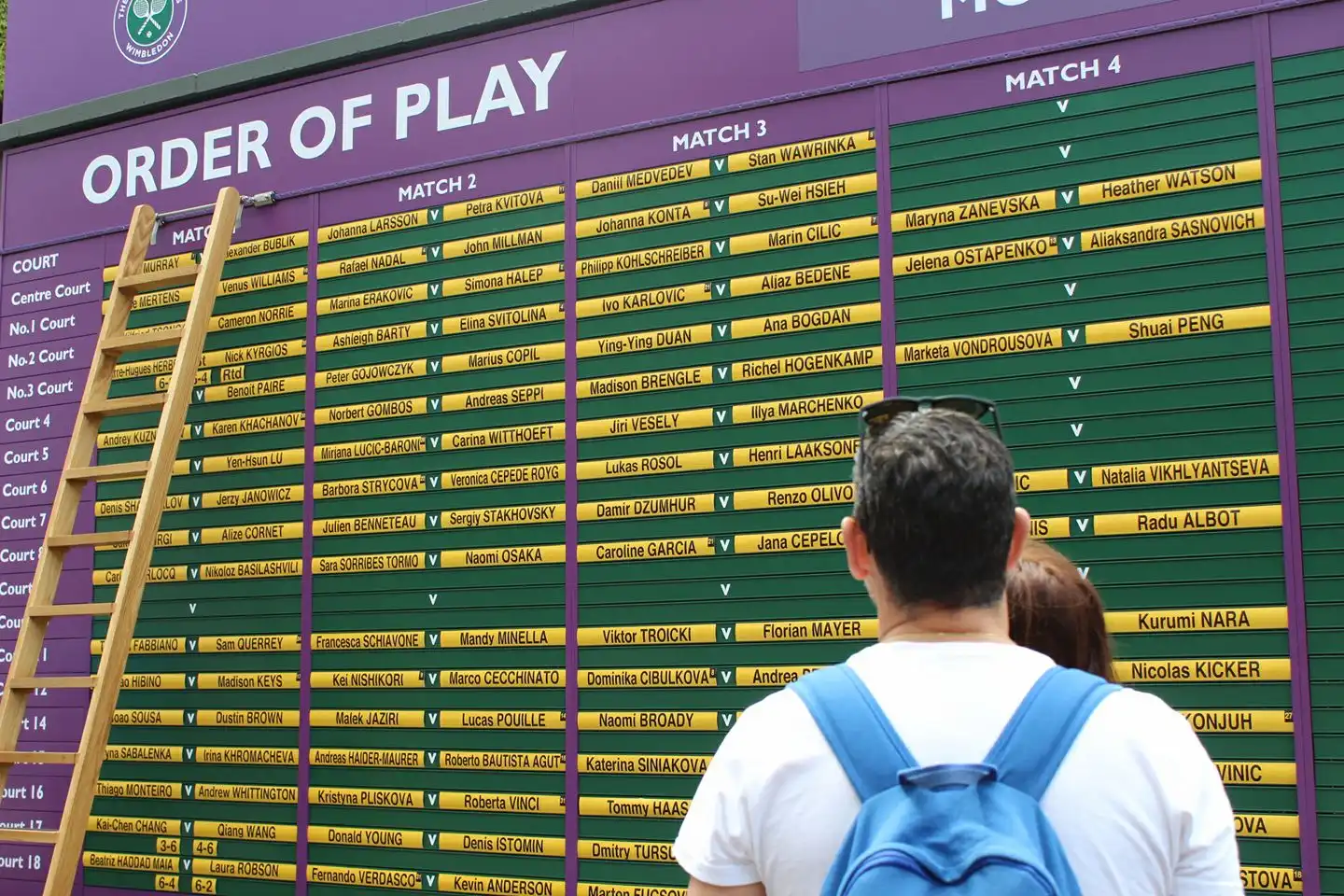
What Makes Wimbledon so Special?
Written by Liran Froind | Last updated on March 11, 2026
A handful of sporting events feel unmistakably themselves, and Wimbledon is one of them. It is the oldest tennis tournament in the world, the only Grand Slam still played on grass, and the championship that most obviously blends elite sport with ritual, setting and history.
That is why a day at Wimbledon feels different from almost any other ticket in tennis, whether you are looking at a Grounds Pass or comparing options for Wimbledon tickets for one of the show courts.
Part of that difference is scale. Wimbledon welcomed 548,770 guests across the 2025 Championships, yet for all that size it still manages to feel unusually distinctive. Packed outer courts, formal traditions, a very English visual identity, and knowing that every match is part of a long tradition.
No Ballot, No Queue!
Wimbledon’s long history
Wimbledon began in 1877, making it the oldest tennis tournament in the world, while the All England Lawn Tennis and Croquet Club dates back to 1868.
The Championships moved from Worple Road to Church Road in 1922, and until the Open Era began in 1968 only amateurs could compete.
Before 1922, the defending gentlemen’s singles champion advanced straight to the final through the old Challenge Round system.
That history still shapes the tournament’s atmosphere now. Wimbledon does not just mention its past and move on; it builds the modern event around it, through the honours boards, the club setting, the traditions and the symbolic pull of the show courts.
That continuity is a large part of why the place feels weightier than an ordinary stop on the calendar.
What is unique about Wimbledon?
The clearest answer is that Wimbledon combines elements no other Slam can quite match in the same way.
It is the oldest major, the only grass-court Slam, the most tradition-conscious of the four and the one whose visual identity is strongest from the first glance.
The green and purple branding, all-white clothing, immaculate lawns and carefully staged setting make it recognisably Wimbledon before the scoreboard even starts turning over.
It is also unusual in the way it mixes public access and sheer prestige. You can sit on The Hill with a Grounds Pass, queue overnight for a show-court ticket, or aim for the main arenas with Centre Court Wimbledon tickets or tickets for No.1 Court at Wimbledon.
Few major events feel both this public and this ceremonial at the same time.
Why is Wimbledon so prestigious?
Strictly speaking, all four Grand Slam singles titles are equal in ranking points.
Prestige is not something the tours score on a table. But Wimbledon has long held a special place in tennis because it is the oldest Slam, the most tradition-bound and the one most closely associated with the sport’s shared mythology.
For players and spectators alike, it feels like the championship most loaded with symbolism.
That prestige is reinforced by setting and ceremony. Centre Court, the Royal Box, the grass, the clothing rules and the club surroundings all contribute to a sense that Wimbledon is not just another tournament. It is the event where the sport’s history feels most visible in the present.
The game’s greatest players win at Wimbledon
Wimbledon’s champions’ rolls tend to look like a shortlist of the game’s most complete players. A cleaner way to show that now is not with an all-surface Grand Slam table, but with a Wimbledon-specific one.
Most successful Wimbledon singles champions in the Open Era
| Player | Wimbledon singles titles |
|---|---|
| Martina Navratilova | 9 |
| Roger Federer | 8 |
| Novak Djokovic | 7 |
| Pete Sampras | 7 |
| Serena Williams | 7 |
| Steffi Graf | 7 |
| Bjorn Borg | 5 |
| Venus Williams | 5 |
That table makes the point more directly than the old one. Wimbledon titles tend to accumulate around players whose games travel well and whose temperaments hold up under a very particular kind of pressure. The tournament does not reward only one style, but it does tend to reward completeness.
Wimbledon is the only Grand Slam on grass
This remains one of the biggest reasons the tournament feels different. Grass produces a lower bounce than clay and usually a quicker, more skidding response than players see at the other majors.
It rewards quick reactions, strong serving, clean ball-striking and efficient movement, while punishing hesitation more quickly than slower surfaces do.
It also changes visibly through the fortnight. The courts begin the event looking pristine and dense, then wear down around the baselines and service boxes as the tournament deepens.
Wimbledon therefore does not just play differently from the other Slams as it also looks different from day one to the closing weekend.
Wimbledon used to go even further, with a special seeding formula that gave extra weight to grass-court results.
That system ended after 2019 and seedings now follow the rankings, but the surface still affects the tournament’s identity more strongly than at any other major.
How much do Wimbledon winners get?
The prize money has moved on sharply from the figures in the original draft.
For last year’s championships in 2025, Wimbledon announced a record total prize fund of €62 million, with the ladies’ and gentlemen’s singles champions each receiving €3 million.
Even first-round singles losers earned €76,398, which shows how much the modern event pays across the draw, not only at the top.
That matters because Wimbledon’s status is not only historical or ceremonial. It is also one of the richest events in tennis, which helps explain why it remains central to the ambitions of elite players even in a crowded calendar.
What the greats say about Wimbledon
Prestige is hard to measure neatly, which is why players’ own descriptions still count the most. Wimbledon is the tournament many champions talk about in almost physical terms:
The courts, the setting, the traditions, and the sense that the history of the sport is somehow still present while you are competing.
Roger Federer said after his 2017 title that “Wimbledon was and will always be my favourite tournament” and that his heroes had “walked the Grounds and the courts here.”
Novak Djokovic called it “the tournament I always dreamed of winning” and “the best in the world, the most valuable one.”
Pete Sampras put it more bluntly. They act like it is the biggest tournament in the world “and they’re right.”
Venus Williams wrote that “there is nothing like playing at Wimbledon” because you can feel “the footprints of the legends of the game” on those courts.
Martina Navratilova once remarked that Wimbledon “makes you feel like a former champion more than any other tournament,” while Serena Williams described it as “extremely special” and “near and dear” to her heart.
Taken together, those comments help explain why Wimbledon’s status is not just about age, clothing rules or royal links. The tournament carries a particular weight with the people who play it, which is usually the clearest sign that its prestige is real.
Wimbledon’s royal connection
Wimbledon’s royal link is not just decorative. The Princess of Wales is Patron of the All England Lawn Tennis Club, and the Royal Box remains one of the event’s best-known traditions. That gives the Championships a layer of ceremony very few sporting events can reproduce convincingly.
The royal connection matters because it feeds the event’s public image without overpowering the tennis. Wimbledon still works first as a championship but it is also a social and cultural occasion in a way that feels broader than sport alone.
Why is Wimbledon white only?
The all-white clothing rule is one of the tournament’s strongest signatures. Wimbledon still requires competitors to be dressed in tennis attire that is almost entirely white from the moment they enter the court surround, with tightly limited trim and branding.
It is one of the clearest ways the event protects a visual identity that no other Slam tries to copy.
At the same time, the rule has evolved. In 2023 Wimbledon updated its clothing rules to allow female players to wear solid mid or dark-coloured undershorts, provided they are no longer than the shorts or skirt. So even one of the tournament’s most famous traditions has been adjusted where practical concerns demanded it.
For spectators, things are much looser. There is no formal dress code for ordinary ticket holders, but Wimbledon still tends to reward a slightly smarter standard than many other sports events. If you are heading to a show court, smart-casual is usually the safest reading of the room.
A few Wimbledon facts and figures
The Championship’s official 2025 data shows 18 Championship courts, 38 courts in total at the All England Club site, and 548,770 visitors across the fortnight.
At the start of each day, 46 tins of new balls go to Centre Court and No.1 Court, with 21 tins taken to each outside court.
Those figures matter because they show how carefully managed the event is behind the scenes. Wimbledon presents itself as calm and orderly, but underneath that surface sits a huge and highly choreographed operation from groundskeeping to scheduling to crowd flow.
Some of the many unique traditions at Wimbledon
The traditions are not window dressing. They are part of the event’s identity and help explain why attending Wimbledon feels like entering a distinct sporting world rather than simply a stadium complex.
Strawberries and cream have been associated with the Championships since 1877, and they remain a central part of the Wimbledon experience. Pimm’s remains just as visible, especially on The Hill and the Tea Lawn.
Strawberries and cream at Wimbledon
Strawberries and cream work because they fit the timing and setting of the event so neatly. Wimbledon falls in early summer and the dish feels recognisably English without seeming forced.
Pimm’s at Wimbledon
Pimm’s does much the same job. It is not unique to Wimbledon but Wimbledon has absorbed it into the event’s public image so completely that it now feels like part of the visual grammar of the fortnight.
The Hill at Wimbledon
Even if you never get near Centre Court, Wimbledon still has one of the best public viewing areas in sport. The Hill on Aorangi lets Grounds Pass holders watch the action on the big screen and has become one of the tournament’s signature spaces.
A lot of Wimbledon’s identity comes from walking, watching, queuing, eating and drifting between courts before settling somewhere to absorb the event properly. The tournament works as a full environment, which is one reason it feels larger than any one match.
Traditions that have changed with the times
Wimbledon is often described as resistant to change but that is only half true. Middle Sunday, once a rest day intended to protect the grass and preserve the old rhythm of the fortnight, became a permanent day of play from 2022.
Electronic line calling was adopted for 2025, and finals-weekend scheduling was adjusted the same year.
That gradual adaptability is one reason the tournament still feels alive rather than museum-like. Wimbledon changes carefully, but it does change, which allows it to preserve its identity without turning tradition into parody.
Some unforgettable Wimbledon moments
Boris Becker’s 1985 title remains one of the great shock victories in tennis history. He won the gentlemen’s singles title at 17 years and 227 days, becoming the youngest men’s singles champion in Wimbledon history.
Then there is the 2008 final between Roger Federer and Rafael Nadal, still regularly discussed as one of the greatest matches Wimbledon has staged.
The 2010 first-round match between John Isner and Nicolas Mahut remains the longest in tennis history at 11 hours and five minutes over three days.
And People’s Monday in 2001, when rain pushed the event into a third week and thousands of extra final tickets were suddenly released, remains one of the most unusual ticketing days in the Championships’ history.
Who has won the most singles titles at Wimbledon?
Roger Federer holds the men’s singles record with eight Wimbledon titles. Martina Navratilova holds the women’s singles record with nine. Those two records say a lot about the event’s demands. Both players married technical excellence to a kind of ease on grass that very few champions have ever matched.
More about the All England Lawn Tennis and Croquet Club
The club hosting The Championships predates the event itself, and the wider site is part of what gives Wimbledon its unusual feel. The grounds include Championship courts, practice areas and the Wimbledon Lawn Tennis Museum which the club presents as the world’s largest tennis museum.
That matters because Wimbledon’s aura is not only about one fortnight of tennis. It is also about the setting itself. The club, the museum, the honours boards, the quieter grounds and the sense that the tournament’s history lives in a real place rather than in abstract legend.
Buying tickets for Wimbledon
Part of Wimbledon’s identity comes from the fact that its ticketing is not entirely straightforward. The ballot, The Queue, show-court allocations and the sheer competition for popular days all contribute to the sense that attending requires a little more thought than many other events.
One way to get Wimbledon tickets is to check www.healtharomatherapy.com. We are a ticket comparison site, with up-to-date availability across multiple reliable vendors for Centre Court and Court No. 1 across every stage of The Championships.
So, what makes Wimbledon so special?
It is the combination rather than any one thing. Wimbledon is old, but not stale. Formal, but not lifeless. Global, but still rooted in one corner of London.
It has the strongest visual identity in tennis, the only grass-court Slam, one of the sport’s biggest prize funds, and a set of traditions that still feel alive in the present event rather than preserved behind glass.
That is why Wimbledon still feels special to people who already know the obvious facts. It does not just stage elite tennis. It stages it in a way that makes history, ritual, atmosphere and modern competition feel like parts of the same thing.
If you’re ready to be part of the action, compare ticket prices with www.healtharomatherapy.com and don’t miss out on one of the world’s most famous and prestigious sporting events.


