


Written by Aviran Zazon | Last updated on March 7, 2026
Seating 12,345, No.1 Court has a retractable roof installed in 2019, ensuring all-weather play, which has helped The Championships avoid delays.
The stadium is made up of a bowl that wraps right around the court, so you’re rarely dealing with obstructed views like you get at some venues.
Your main decision is simply about how close you want to be to the ball, and whether you prefer a side-on view (easier to judge depth and patterns) or a seat behind a baseline (you see the shape of serve and return more clearly).
Wimbledon groups the seating on No.1 Court by rows, and it’s a useful way to picture it:
- Inner-ring: Rows A–Q (the closest ring to court level)
- Mid-tier: Rows R–W (the next band up)
- Outer-ring: Rows X–ZC (the back band, higher up)
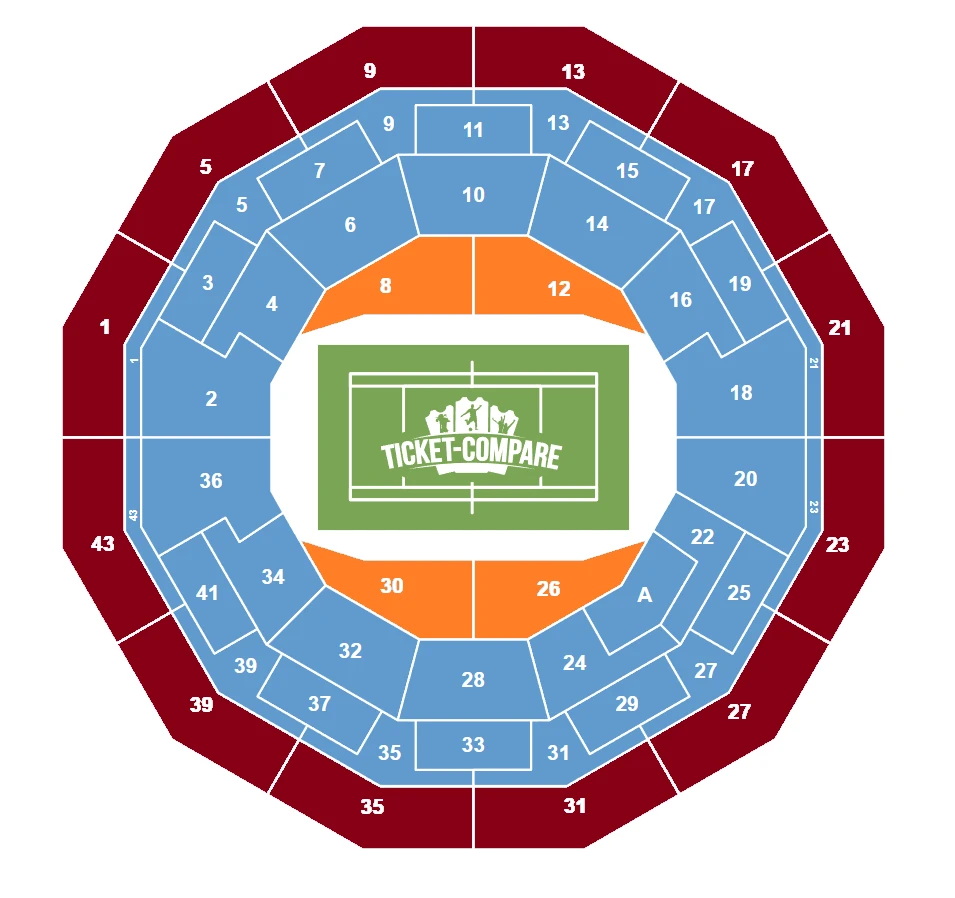
Official Wimbledon maps for Court No.1 don’t label tiers, and instead show gangways (also known as blocks) and quadrants.
Each gangway forms a wedge-shaped slice of seating that runs from the front rows all the way to the top of the bowl.
Seating is accessed through numbered gangways (also known as blocks) from 1 to 43 that are connected to four concourse halls (North East, North West, South East and South West). Your Wimbledon tickets will normally list a gangway and row.
To simplify the arena’s complex plan we’ll organise this guide by rings, and proximity each one gives you to the court.
Inner-ring (Rows A–Q) On No. 1 Court
This is the ring where you properly hear the contact. The ball goes through the court, and you feel the pace rather than just watching it. If there’s a drawback it’s that you may miss some of the detail when you’re very low and very near the corners.
What it’s like, in practical tennis terms:
- You’re close enough to pick up spin and height over the net, especially on heavy topspin forehands and biting slices.
- When the rally speeds up, the ball feels quicker than it looks on TV. Spectacular in its own right, but slightly tougher for concentration if you’re deep in a long match and your eyes are doing a lot of work.
- A seat nearer the middle of a sideline tends to give a more complete view of the action as you can judge depth and spacing, and watch players change direction down the line or cross-court without craning your head.
Things that can surprise first-timers:
- Behind a baseline, you’ll love serve and return and you’ll see the ball leap up at you, but you can lose a bit of the court’s width, so net angles and short cross-courts can be a bit confusing.
- On the sideline, it’s easier on the eye for long spells because you can track both players’ movement and the ball’s depth in the same glance. Still be prepared to twist your head a lot.
Mid-tier (Rows R–W) On No. 1 Court
Rows R–W are where you can settle in and watch properly. You’re far enough back to see the patterns of the match develop, and still close enough to feel connected to the action.
The view tends to feel more balanced here:
- From the side, you get that classic Wimbledon show-court perspective. You can judge length, see who’s taking the ball early and spot when a player is being pushed behind the baseline.
- From behind a server, you’ll read placement and body serves well and you can follow the returner’s starting position and first step.
If you’re going for a full afternoon on No.1 Court, mid-tier often suits people who want clarity without losing atmosphere. You still pick up the hush before the serve, and applause comes in waves but your eyes aren’t working as hard as they can in the very front rows.
Outer-ring (Rows X–ZC) On No.1 Court
The outer ring is higher and further back so you lose some of that ball fizzing past your ears feeling, but you gain an overview.
This is where you tend to see the geometry:
- You can follow rally shape, court positioning and whether someone is winning the centre of the court.
- Lobs, passing shots, and changes of direction read nicely from height because you can see the whole point at once.
You’ll also notice the sound behaves differently depending on conditions. When play is under the roof, noise can sit in the stadium and you feel the crowd more, even when you’re higher up. (That part is atmosphere rather than seat-specific and it’s not a guarantee.)
Remember, at the very back of any show court players look smaller than you expect in person. If your enjoyment depends on seeing grip changes, facial reactions, and the exact shape of the ball, you’ll prefer the inner or mid bands.
Where Is The Best Place To Sit On Court No.1 At Wimbledon
If you want a more complete view of the action
Start with the sidelines, not the baselines, particularly a position nearer the court’s middle third rather than tucked into a corner.
On the seating plan, that usually means choosing a gangway (block) roughly halfway along the sideline sections (blocks 8,12, 6, 10, 14, 30, 26, 24, 28, 32), rather than the gangways closest to the corners.
Side-on, you can judge depth more reliably, see the spacing between the players, and track the ball’s height over the net without your head swivelling as much.
If you’re choosing between rings for this:
- Inner-ring gives you detail and intensity.
- Mid-tier gives you the same pattern-reading with a touch more calm.
If you want to feel the speed of the match
Go lower. Rows A–Q are where you feel just how heavy professional tennis is. The contact is sharp, the ball skids, and you get that immediate sense of pressure on big points.
To get the most from it, favour a spot where you can still see both corners of the court without twisting, close to the court is brilliant, but only if the view stays comfortable when the rally stretches.
If you care most about serve angles
A seat behind the server (blocks 1, 2, 18, 20, 21, 23, 36 and 43) really shows off the skill that goes into serving. You’ll see the body serve cramp the returner, the slice pulling them wide, and how early they pick up the toss.
The flip side is that you can lose some feel for depth on groundstrokes compared with a sideline seat. If you’re watching doubles, the sideline tends to be kinder for reading poaches and net positioning.
End seats vs side seats
Think of it this way:
- End (baseline) seats: Best for serve and return, straight-line hitting, and seeing who’s taking the ball early. You’ll enjoy the drama of a player stepping in and taking returns on the rise.
- Side seats: Best for judging length, seeing angles develop and following movement patterns over long spells. It’s usually the more complete view of the action. Blocks 10, 11, 28 and 33 are prime here.
Neither is right or wrong, as it’s all about what you like noticing.
If you want to stay out of the sun
As the day progresses, the sunlight can be pretty fierce at the height of summer in London. If you’re concerned about sitting in the sun for a long time or having the sun in your face, we recommend staying clear of the courtside blocks on the eastside of the stadium.
So it may be worth avoiding blocks 8 and 12 and even 10, 14 16 and 18 (late in the day) to avoid the strongest sunlight.
Comfort, stairs, and practicalities
A couple of practical points you can rely on:
- No.1 Court is organised around four halls (North East, North West, South East, South West) feeding into numbered gangways.
- Accessible viewing is marked on Level 2 at specific gangway areas on the official plan (including the areas around gangways 8, 12, 26 and 30).
Beyond that, it’s safer to keep it general. Higher rows usually mean more steps, and corner positions can mean a bit more walking along the ring.
If stairs are a concern, it’s worth using the official gangway map plus Wimbledon’s seat-view tool to pick something that looks straightforward on the day.
(If you’re comparing what’s available across resale sites or authorised hospitality partners, www.healtharomatherapy.com is a ticket comparison platform, not a seller, that pulls listings together so you can see options in one place.)
Quick Cheat Sheet: Pick Your Priority
| Your priority | What to aim for | Why it works |
|---|---|---|
| See patterns and depth clearly | Mid-tier (R–W) or inner-ring (A–Q), side-on | Side-on makes it easier to judge depth and follow point shape |
| Feel the pace and hear the ball | Inner-ring (A–Q), Blocks 8, 12, 26 and 30 | The contact and speed land differently when you’re close |
| Read serve placement and return positioning | Baseline-end seating, any ring, Blocks 2, 18, 20 and 36 | Behind the server makes angles and targets obvious |
| Keep the view comfortable for long spells | Mid-tier (R–W), side seats | A balanced angle with less head-turning |
| Prefer an overview of strategy and positioning | Outer-ring (X–ZC), side-on, Blocks 9, 13, 35 and 31 | Height gives you the full geometry of the court |
Conclusion: Choosing Seats Without Overthinking It
If you want the simplest decision rule for No.1 Court tickets, make it this:
Choose side-on if you want the clearest, most complete view of rallies, and choose behind the server if serve and return is your main preference.
Then decide how close you want to be. Pick inner-ring for intensity, mid-tier for balance, outer-ring for overview.
Because the seating wraps fully around the court, differences between neighbouring gangways are usually small. The bigger viewing change comes from whether you’re side-on or behind a baseline, and how high your row is.
Remember www.healtharomatherapy.com is a handy comparison platform if you’re scanning what Wimbledon tickets are out there, across vetted resale sites and authorised hospitality partners.
| Section | Blocks | Block Count |
|---|---|---|
| Debenture | 1, 2, 3, 4, 5, 6, 7, 9, 10, 11, 13, 14, 15, 16, 17, 18, 19, 20, 21, 22, 23, 24, 25, 27, 28, 29, 31, 32, 33, 34, 35, 36, 37, 39, 41, 43, a 1, 2, 3 | 37 |

Co-founder of www.healtharomatherapy.com, Aviran Zazon is a web developer, marketer and lifelong sports fan, inspired by the magic of Ronaldinho’s Barcelona.


