


Written by Aviran Zazon | Last updated on March 7, 2026
The centrepiece at Wimbledon has had a retractable roof since 2009, allowing a full schedule in all conditions.
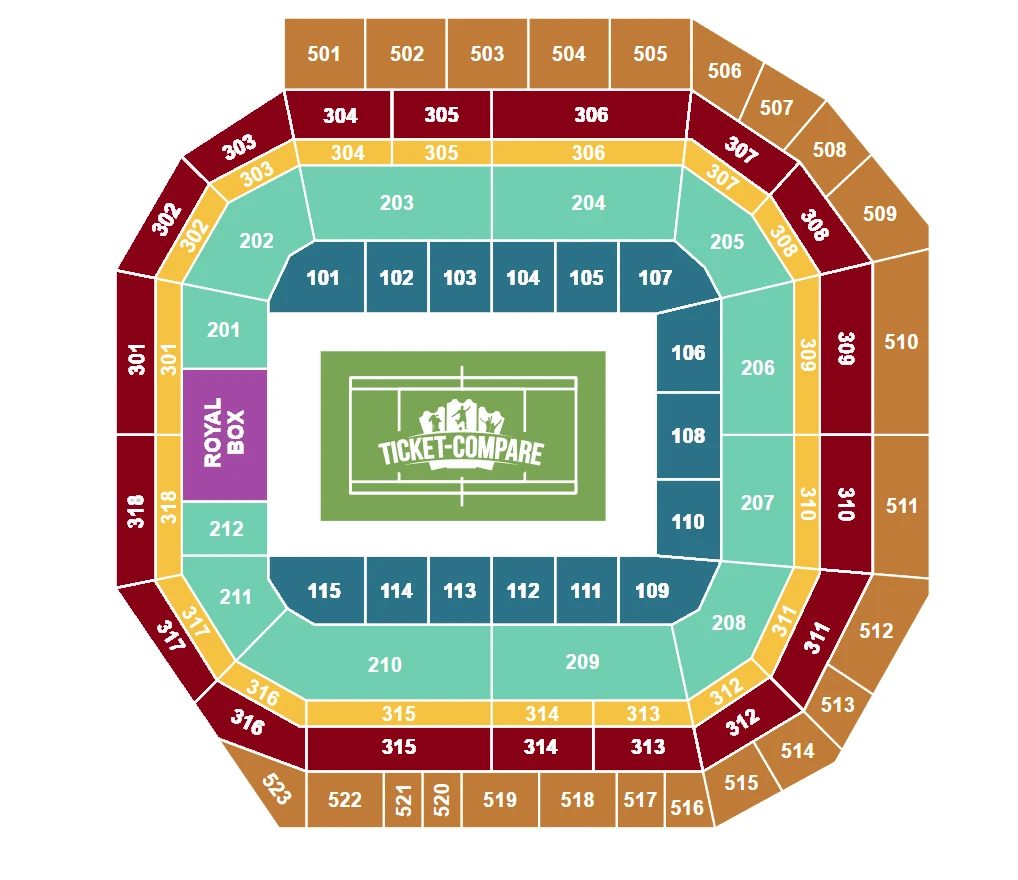
Centre Court is a bowl with four public seating levels: Level 100, Level 200, Level 300, and Level 500 (there isn’t a Level 400 on the numbering).
Your seating choice changes what you actually see. So that is whether the match feels like it’s happening right in your lap, or whether you get an all-encompassing view of the action.
The quickest way to picture it is this.
The 100s are close enough that you hear the contact and feel the speed of the ball; the 200s sit at a classic tennis height where you can judge depth without losing the ball; and the 300s and 500s pull you back for a cleaner overview, with players smaller in the frame.
As a practical point, Centre Court uses gangway numbers (also known as blocks) to get you into the right part of the bowl.
The plan groups gangways by Halls (North West, North East, South West, South East), and shows which gangway ranges sit in each level. In other words, the number on your ticket is your doorway into the right slice of the stadium.
For another landmark, the Royal Box is on the plan at the south end of the court, set into the mid-tier side of the bowl. It’s useful as a reference point when you’re orienting yourself, even if you’re nowhere near it.
The players will also enter the court from an opening right below the Royal Box, adding a bit of drama and ceremony to the biggest matches.
Level 100 Seating On Centre Court
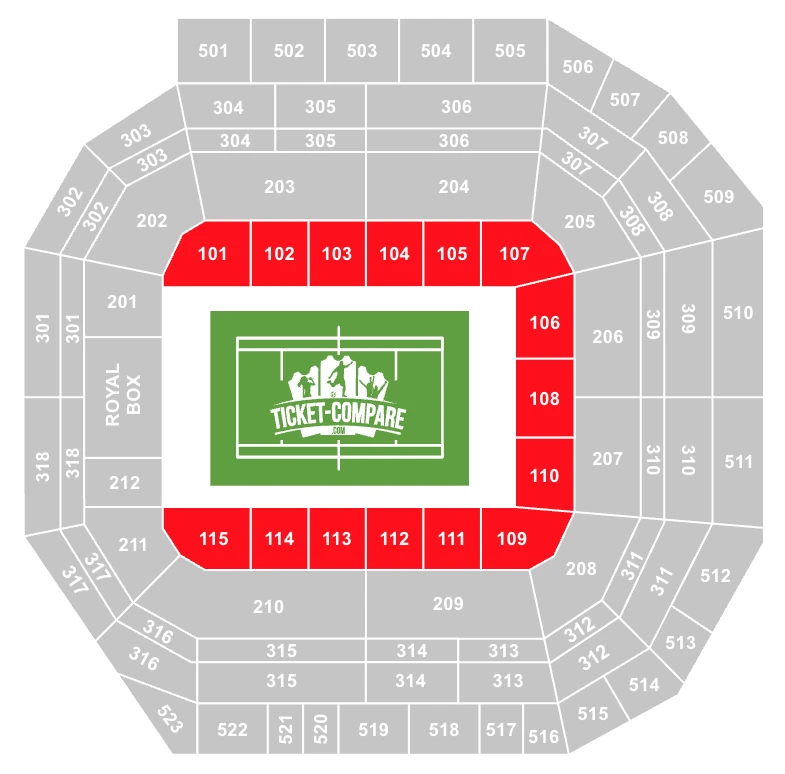
Level 100 is the most intimate way to watch tennis on Centre Court. You’re close enough that the ball feels heavy, the footwork is louder, and the hush before the serve is properly felt rather than just observed.
Sightline-wise, it’s a trade as while you get detail and speed, you give up some of the fuller view of the court.
What it’s like from down there:
- You’ll often be watching slightly upwards, especially in the front rows, which makes the near end feel huge and the far baseline feel a bit more distant.
- A side-on view in the 100s can be brilliant for net play and for hearing the match, volleys, calls, the little exchanges with ball kids, but it’s not the easiest place to judge the ball’s depth at the far end.
- Seats that are more towards the ends give you more of a behind the server feel at one end, which can make serves and returns easier to read, even if you’re still low.
When Level 100 makes most sense
- You want to feel the pace and atmosphere more than you want a perfectly balanced view.
- You like seeing technique up close: grip changes, split-steps, that instant of contact.
- You’re happy with a slightly less complete view of patterns, in return for immediacy.
Things to be realistic about
- Very low rows can mean more heads and movement in your sightline, because everyone around you is also close to the action.
- The closer you are, the more your neck and eyes do little adjustments during long rallies, not a problem for everyone, but it’s part of the bargain.
Level 200 Seating On Centre Court
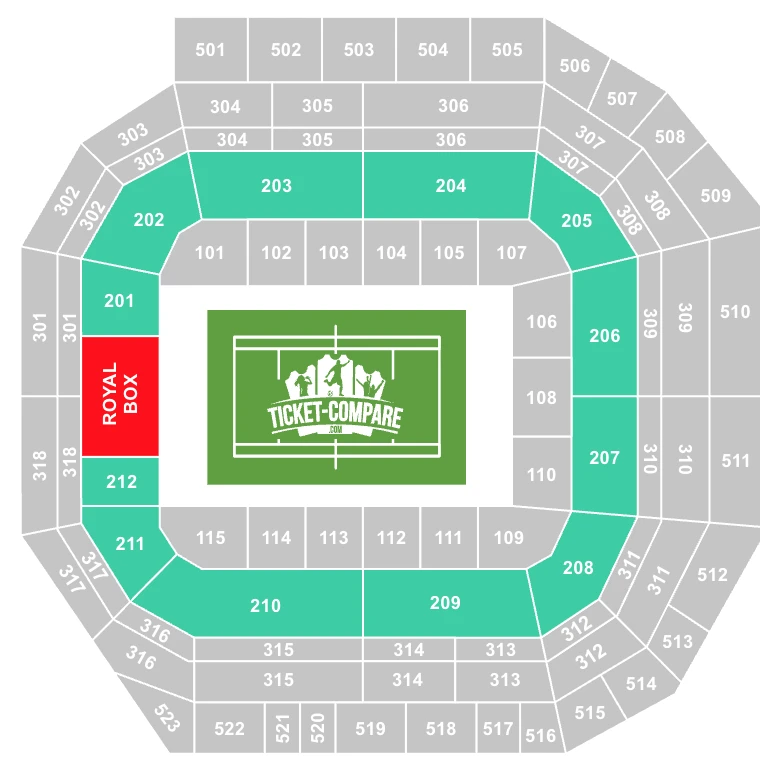
If you’ve ever heard people talk about Centre Court having a proper tennis view, they usually mean something like Level 200. You’re high enough to see the whole court as a shape, and close enough that the ball still goes through the court with real presence.
This is where the match can be seen most cleanly:
- You can judge depth more naturally, whether a forehand is landing deep, or a defender is being pushed back and how much space is being created.
- It’s easier on the eye for long spells because your view isn’t constantly interrupted by movement in front of you.
- A seat nearer the ends gives you a more direct look at serve and return patterns; so a seat nearer the sides leans more into rally geometry as down the line and cross-court changes show up clearly.
Debentures, briefly and factually.
Centre Court has 2,520 debenture seats, and debenture tickets are the only Wimbledon tickets described as freely transferable which is one reason these seats are commonly resold on sites like www.healtharomatherapy.com outside the ballot and public sale.
Level 300 Seating On Centre Court
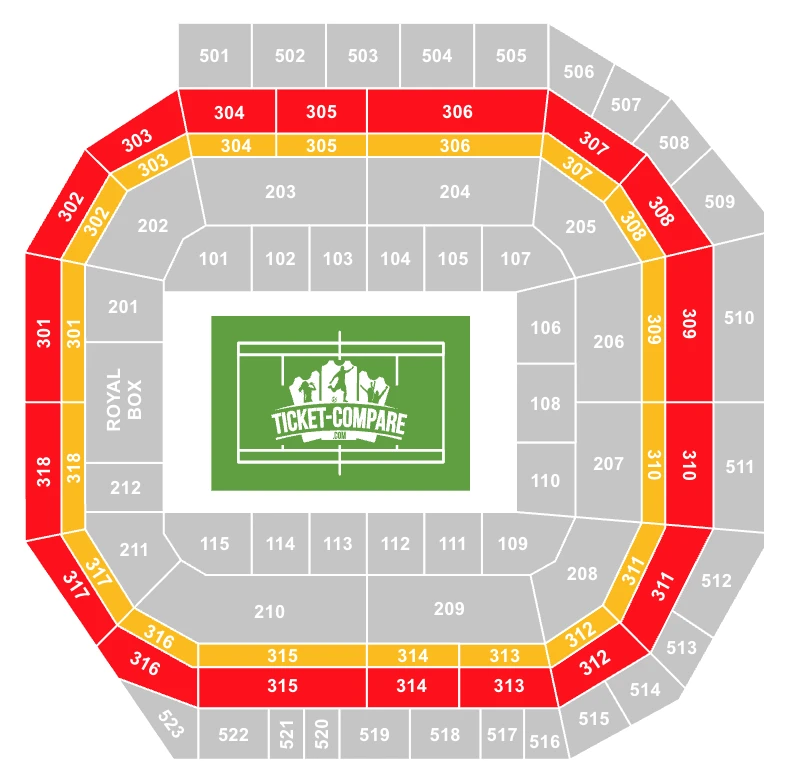
Level 300 pushes you into a calmer view of the match. You lose a bit of the physical thump, and you gain time. That means more opportunity to see spacing, to pick up positioning, and to follow the ball’s flight without feeling you’re right on top of it.
From Level 300, rallies tend to make more sense:
- You can track height and spin more easily, because you’re looking down at a slightly wider picture.
- Changes of direction show up clearly, so a player opening cross-court, then finishing down the line is easier to see as a pattern.
- It’s also a good level for watching doubles, because the formations and poaching movement are clearly visible.
The compromise is obvious: players are smaller, and the sensation of pace is softer. You’ll still hear the contact, especially when the crowd quietens, but you’re not living inside it in the same way as the 100s and 200s.
Level 500 Seating On Centre Court
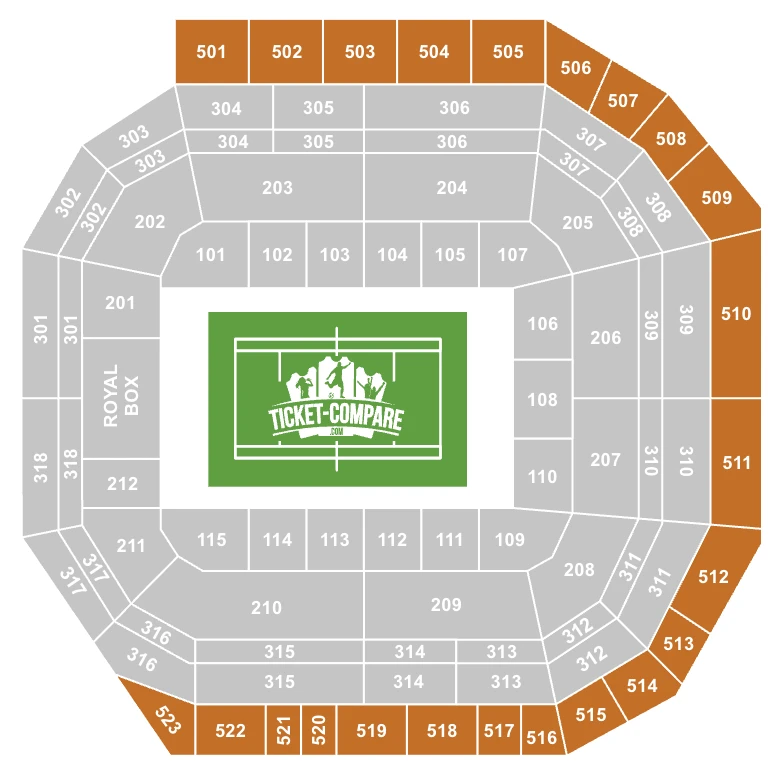
Level 500 is the top ring, and it gives you an almost bird’s eye perspective. If you like watching tennis almost like a coach, seeing the spacing, the height over the net, and how points are constructed, this level can be really satisfying.
What stands out up here:
- The geometry is clear. You can follow shapes of rallies and see where players are trying to land the ball, even when pace is high.
- You tend to get a steadier view with fewer distractions, because you’re well above the movement at court level.
What you give up is the sense of proximity. Big serves look less violent and touch shots look less miraculous until you see the opponent’s reaction. If you’re someone who mainly goes to feel the speed and sound this level can feel a step removed.
On the official plan, some accessible viewing markers are shown at specific gangways (including 517 and 521, and also 101, 109, 209 and 507).
Beyond that, it’s safest not to assume anything about lifts, step-free routes, or seating layouts without checking the access information that comes with your ticket or Wimbledon’s own guidance.
Where Is The Best Place To Sit On Centre Court At Wimbledon
If you want a more complete view of the action
Look for height that lets you see both baselines properly while keeping the ball at a comfortable angle. For most people, that points you towards Level 200, and then Level 300 if you prefer an even cleaner overview.
A good complete view usually means:
- Enough elevation to judge depth (deep vs short is obvious),
- A central-ish angle so you’re not watching the net too edge-on,
- And a sightline that stays calm during long rallies.
If you want to feel the pace of a match
Go lower. Level 100 is where the action becomes physical. You hear the contact, you pick up the spin because you can see the racket work and applause comes in waves right around you.
If you want pace and a steadier view of the whole court, Level 200 is the usual compromise. Still close enough to feel it but high enough that your eyes aren’t constantly adjusting.
For a clear view of the scoreboards
As the main scoreboards, updated with LED screens in 2008, are tucked into the corners on the north-west and south-east sides, the end seats have a slightly clearer view of the scoreboards than the side seats.
The difference isn’t huge, and can vary from gangway to gangway, but this is a minor factor to keep in mind.
To avoid the afternoon sun
If you don’t want the sun in your eyes, or simply to sit in strong sunlight for an extended period, it may be a good idea to avoid the courtside gangways/blocks on the east side of the stadium.
By that, we suggest staying clear of blocks 109, 111, 112, 114, as well as 115, 210 and 211 (especially late in the day), which are most likely to be drenched in sunlight for most of the afternoon.
If you care most about serve angles
Serve is about angle and disguise, so your seat position matters as much as the level.
- Seats nearer the ends (behind a baseline) make it easier to read placement so wide, body, and down the T are clearer, and you can see the returner’s starting position and first step.
- Seats along the sides show you the curve of serves and the way players shape the ball, but the precise hit the line placement can be harder to judge because you’re seeing it more across the court than along it.
If serve is your main obsession, choose an end view first, then pick your level based on how close you want to be.
End seats vs side seats
This is the decision that changes the match most.
End seats (behind a baseline):
- More natural for following serve and return.
- Easier to see depth and length, because you’re looking down the court.
- A strong, behind-the-server feel at one end.
Side seats (along the length of the court):
- A classic side-on view that makes patterns and changes of direction easy to spot.
- Great for seeing net play, movement, and how players open angles cross-court.
- Can be a touch less intuitive for judging whether a deep ball really landed on or just inside the baseline at the far end.
Comfort, stairs, and practicalities
Two practical things you can rely on from the official plan:
- Your gangway/block number is your key navigation tool. It corresponds to an entry point by Hall (North West / North East / South West / South East) and by level.
- The plan flags specific accessible viewing locations at gangways (including 101, 109, 209, 507, 517 and 521). If step-free access matters to you, use those official markers as your starting point and check the detailed access guidance attached to your ticket.
Everything else. legroom differences by row, how steep a particular block feels, whether you’ll be near a bar or toilets varies too much to state confidently without a specific, official note.
If you’re comparing what’s available across different sources, www.healtharomatherapy.com is a ticket comparison platform (not a seller) that brings together listings from vetted resale sites and authorised hospitality partners so you can see options in one place.
Quick Cheat Sheet: Pick Your Priority
| Your priority | What to prioritise in the plan | Likely fit |
|---|---|---|
| A more complete view of the action | A central angle with enough height to judge depth | Level 200 first, then Level 300 |
| Feeling the pace and hearing everything | Proximity over panorama | Level 100 (or lower Level 200) |
| Seeing serve and return clearly | Seats nearer the ends (behind a baseline) | End views in Level 200 or Level 100 |
| Following rally shapes and spacing | Side-on view with elevation | Side views in Level 300 or Level 500 |
| Calm viewing for long rallies | Fewer sightline distractions, steadier angle | Level 200/300 rather than very low rows |
| Accessibility planning | Use official accessible viewing markers and gangways | Start with the marked gangways on the plan |
Conclusion: Choosing Wimbledon Centre Court Seats Without Overthinking It
If you want the simplest rule of thumb, Level 200 tends to give the most balanced Centre Court view, close enough to feel the match, high enough to understand it cleanly.
Drop to Level 100 if you want extra atmosphere and real proximity to the action, and move up to Level 300/500 when you mainly want the whole-court picture and a clearer view of the match patterns.
Once you’ve picked your level, decide whether you’d rather be side-on (clear geometry, net play, movement) or behind a baseline (serve angles, depth, a more direct view down the court).
| Section | Blocks | Block Count |
|---|---|---|
| Debenture Level 200 | 201, 202, 203, 204, 205, 206, 207, 208, 209, 210, 211, 212 201, 202, 203 | 12 |
| Debenture Level 300 | 301, 302, 303, 304, 305, 306, 307, 308, 309, 310, 311, 312, 313, 314, 315, 316, 317, 318 301, 302, 303 | 18 |
| Debenture Level 500 | 501, 502, 503, 504, 505, 506, 507, 508, 509, 510, 511, 512, 513, 514, 515, 516, 517, 518, 519, 520, 521, 522, 523 501, 502, 503 | 23 |

Co-founder of www.healtharomatherapy.com, Aviran Zazon is a web developer, marketer and lifelong sports fan, inspired by the magic of Ronaldinho’s Barcelona.


